Banana screen vs horizontal vibrating screen: telling them apart from overhead
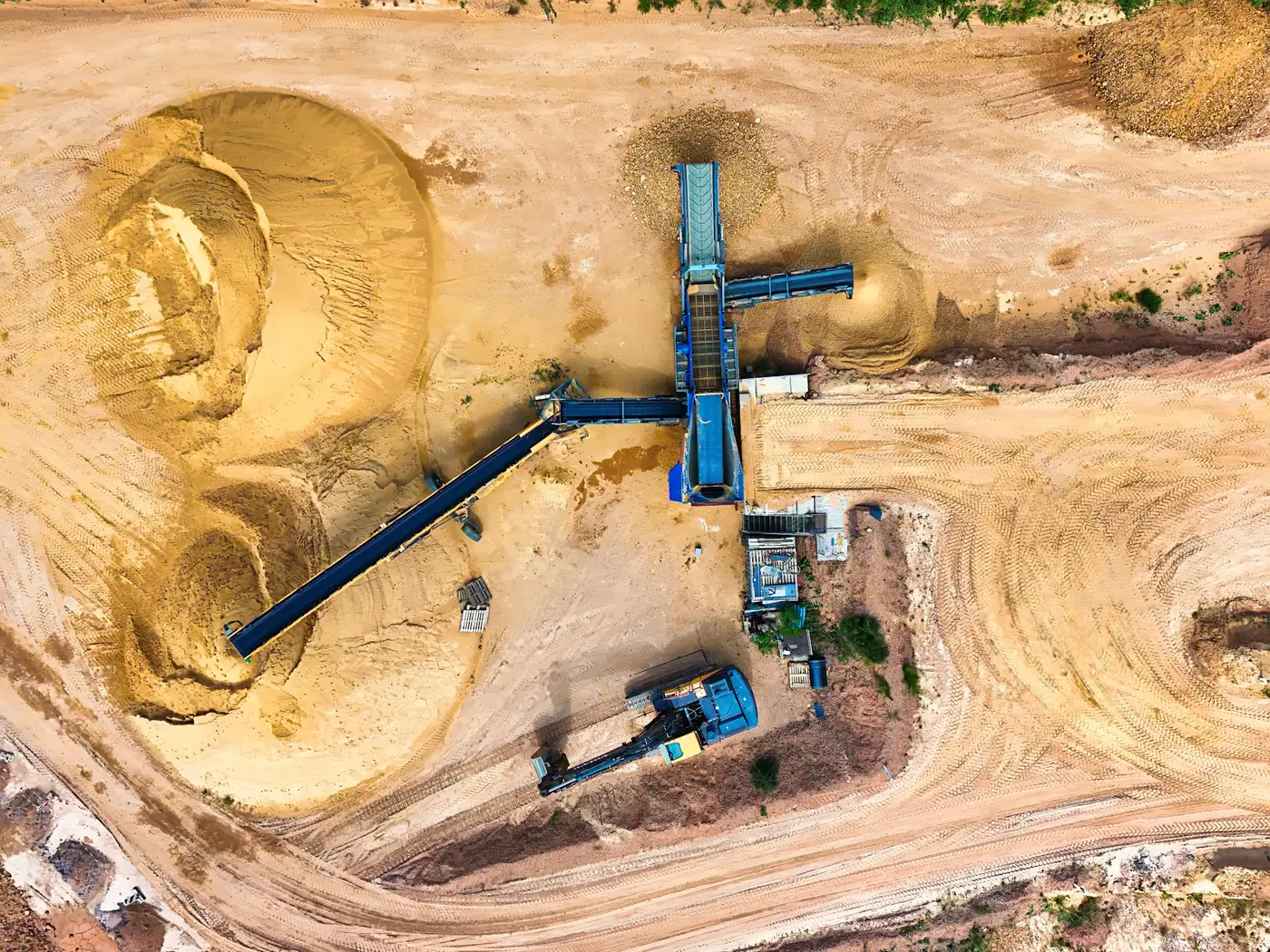
A screen box reads the same from 2,000 feet whether it's running limestone or sand and gravel: a long rectangular structure sitting on spring isolators, feeding a stack of conveyors below. The trick is telling which screen type you're looking at, because the answer tells you something about tonnage and product spec that matters if you're trying to size what a plant could buy next.
Horizontal vibrating screens: flat deck, even shadow
A horizontal screen sits close to level across its whole run, usually tilted a few degrees at most. From overhead that shows up as a shadow line that stays roughly the same width from the feed end to the discharge end. No kink, no step change in the shadow. The support legs underneath are close to uniform height too, since the deck doesn't change pitch.
These units show up doing scalping and classifying duty, often in pairs or stacked two-high in a screen tower. If you see two screen boxes of similar footprint feeding separate stockpile conveyors side by side, that's usually a horizontal pair splitting a product into more size fractions, not one high-tonnage unit.
Banana screens: the shadow kink gives it away
A banana screen (the trade calls it multi-slope, and that's the more useful term for imagery work since "banana" describes the curve you're trying to spot) runs steep near the feed, around 25 to 30 degrees, then flattens out toward discharge, sometimes in two or three distinct sections rather than one smooth curve.
That change in pitch is the tell. Walk your eye along the screen box shadow from feed to discharge: on a banana screen you'll see the shadow narrow or shift partway along, because the deck angle changed and the sun is hitting a different face. On a horizontal screen that shadow stays flat the whole way.
The support steel backs this up. Because the feed end sits higher to get that steep entry angle, the legs at the feed end of a banana screen are noticeably taller than the legs at discharge. You're looking at a visible step-down in support height, not a uniform row of legs. Horizontal screens don't have that step; the legs look the same height end to end.
Tonnage is the other clue, though it's a softer one. Banana screens get specified where a plant needs to push a lot of material through a shorter screen footprint, commonly high-volume sand and gravel operations or aggregate plants running fines-heavy feed. If the screen box sits under a noticeably bigger stockpile system and feeds three or four discharge conveyors instead of one or two, that leans banana even before you've confirmed the shadow kink.
Incline screen vs banana screen: single slope, no step
An incline screen is the easy case once you've got the other two sorted. It runs at one constant angle for its full length, typically 15 to 20 degrees, with no mid-body change. The shadow along an incline screen deepens or lightens gradually and evenly as the angle holds steady, and the support legs step down in a smooth, regular progression rather than the abrupt drop you'd see at a banana screen's slope break. If the shadow line along the box looks like one straight ramp with no kink anywhere in the run, you're looking at an incline screen, not a banana.
Why this matters for a replacement read
None of this tells you the make or the exact model sitting on a pad. What it does is let you sort screen plants into tonnage classes without a site visit, which is the whole point when you're trying to figure out which pits in a region are running high-volume configurations likely to need a screen swap versus which ones are running lighter-duty horizontal setups that get rebuilt in place for another decade. A screen type is one line item in a much longer list of crushers, screens, loaders and haulers worth tracking plant by plant, and that's the kind of standing inventory a site like Quarry Equipment Census is built to keep current.
If you're trying to turn that kind of visual read into an actual quarterly count across a region's pits, that's the problem Quarry Equipment Census is built around.